
Active Recall and Spaced Repetition: How Top Students Actually Remember What They Study
Most medical and law students study hard enough to succeed. The problem is that many of them use study methods that create the illusion of learning without producing lasting memory. They reread lecture slides, highlight textbooks, and review notes for hours, only to discover a week later that much of the material they thought they understood has already started to disappear.
The problem is usually not intelligence or effort. In many cases, students are simply using study methods that feel productive without producing durable memory.
Over the past several decades, cognitive scientists have studied this problem extensively, and the conclusions are surprisingly consistent. Two techniques repeatedly outperform almost everything else in the research literature: active recall and spaced repetition.
These methods are now widely used by medical students preparing for the USMLE, law students studying for the bar exam, language learners, engineers, and professionals working in other high-memory fields. They are not trends or productivity hacks. They are among the most well-supported findings in learning science.
This guide explains what active recall and spaced repetition are, why they work so well, and how students can realistically incorporate them into an already demanding study schedule.
Why Most Study Methods Feel Effective but Fail Later
One of the most frustrating experiences in education is realizing that familiarity is not the same thing as memory.
A student can reread a page several times and feel as though they know the material well. The text looks recognizable. The ideas seem understandable. But during an exam, when the information must be produced independently, the memory often collapses.
This is one reason passive study methods are so deceptive. Rereading and highlighting create the feeling of progress because the material becomes visually familiar. Yet recognition is far easier than retrieval.
Cognitive psychologists have repeatedly found that long-term learning depends far less on exposure than most students assume. What matters more is whether the brain is forced to retrieve information from memory. That is where active recall begins.
Active Recall
What Is Active Recall?
Active recall is the practice of retrieving information from memory rather than reviewing it passively.
The procedural difference sounds small, but the cognitive difference is enormous. Instead of rereading a chapter on negligence law, you close the book and attempt to write out the four elements from memory. Instead of reviewing anatomy notes passively, you try to name the branches of the brachial plexus before checking the answer.
The important part is the retrieval itself. Every successful act of recall strengthens the pathway back to that information. This is why flashcards, practice questions, self-testing, and closed-book recall exercises tend to work so much better than passive review.
The Research Behind Active Recall
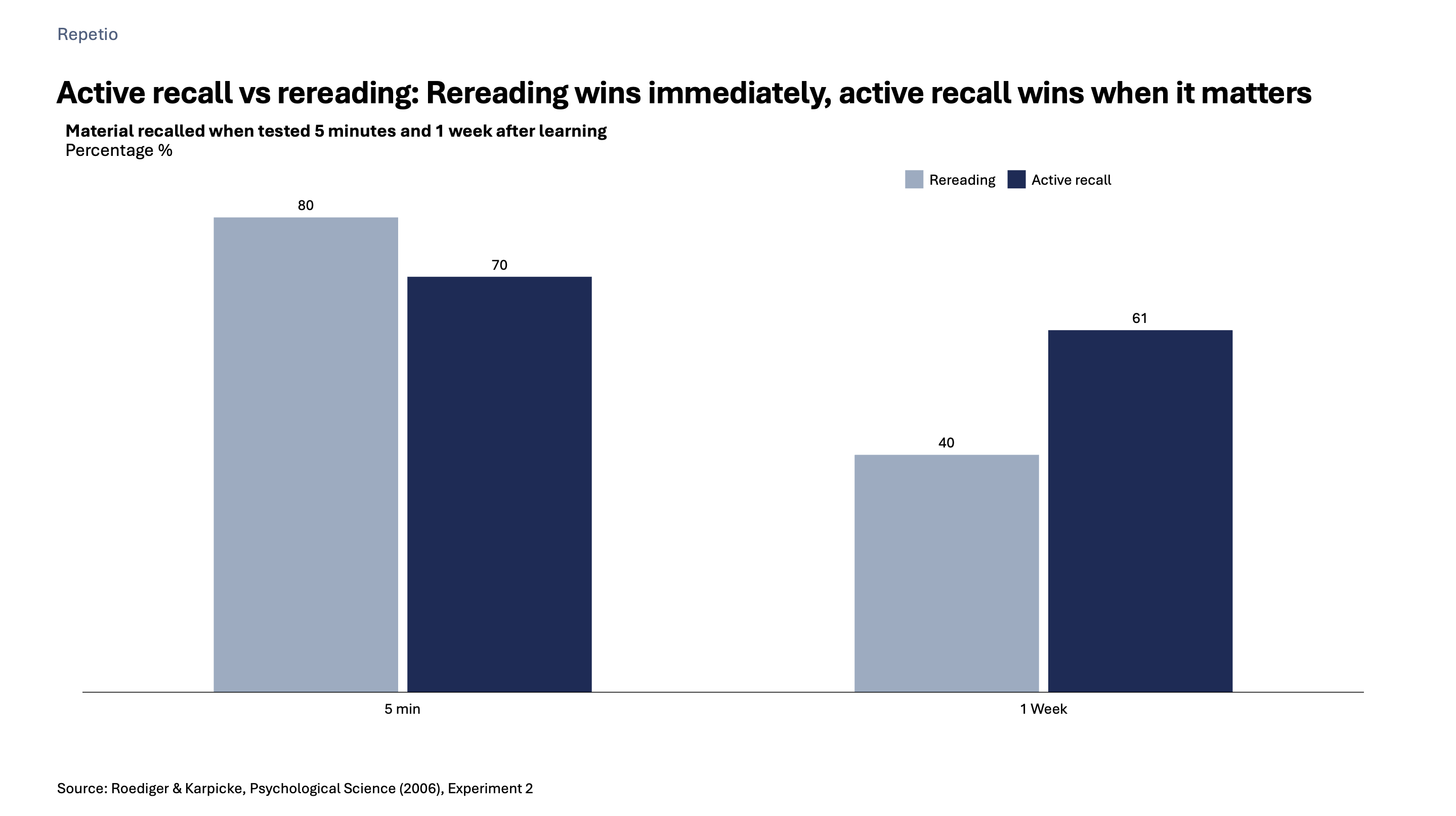
One of the most influential demonstrations of this effect came in 2006, when cognitive psychologists Henry Roediger and Jeffrey Karpicke published a study that significantly shaped modern thinking about learning.
Students were asked to study prose passages and were then divided into two groups. One group reread the material several times, while the other studied the material once and then practiced recalling it from memory.
Immediately afterward, the rereading group performed slightly better, which matched the students' own intuitions about what felt effective. But when both groups were tested again a week later, the results reversed dramatically. The retrieval-practice group remembered about 50% more of the material than the rereading group.
This phenomenon is now widely known as the testing effect, and it has since been replicated across subjects, age groups, and educational settings. The conclusion is straightforward: memory improves through retrieval, not through repeated exposure alone.
Why Active Recall Feels Difficult
Many students abandon active recall because it feels harder than rereading. That discomfort is precisely the point.
Psychologist Robert Bjork describes effortful retrieval as a “desirable difficulty.” The struggle involved in recall strengthens long-term retention. By contrast, passive review often feels smooth and fluent precisely because it demands very little retrieval effort.
This creates a misleading psychological effect. Rereading feels efficient because the material appears familiar, while active recall feels slower because gaps in memory become visible immediately. But those moments of difficulty are often the moments in which learning is happening most effectively.
The Forgetting Curve
Even effective studying faces another challenge: memory naturally decays over time.
The foundational work on forgetting came from the German psychologist Hermann Ebbinghaus in the late nineteenth century. Over a period of years, Ebbinghaus memorized lists of meaningless syllables and tested himself at carefully measured intervals in order to understand how memory changed over time. The result became known as the forgetting curve.
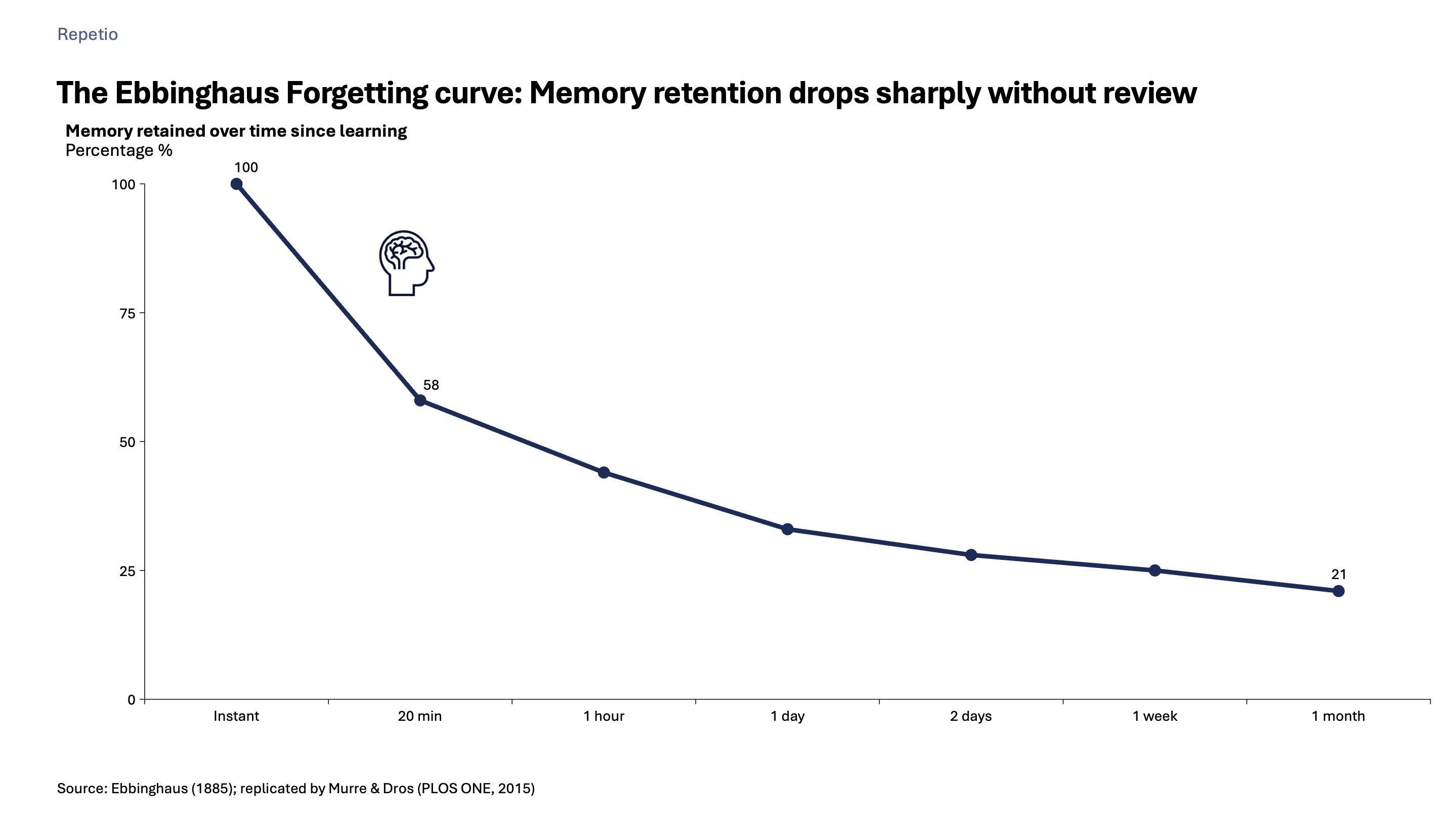
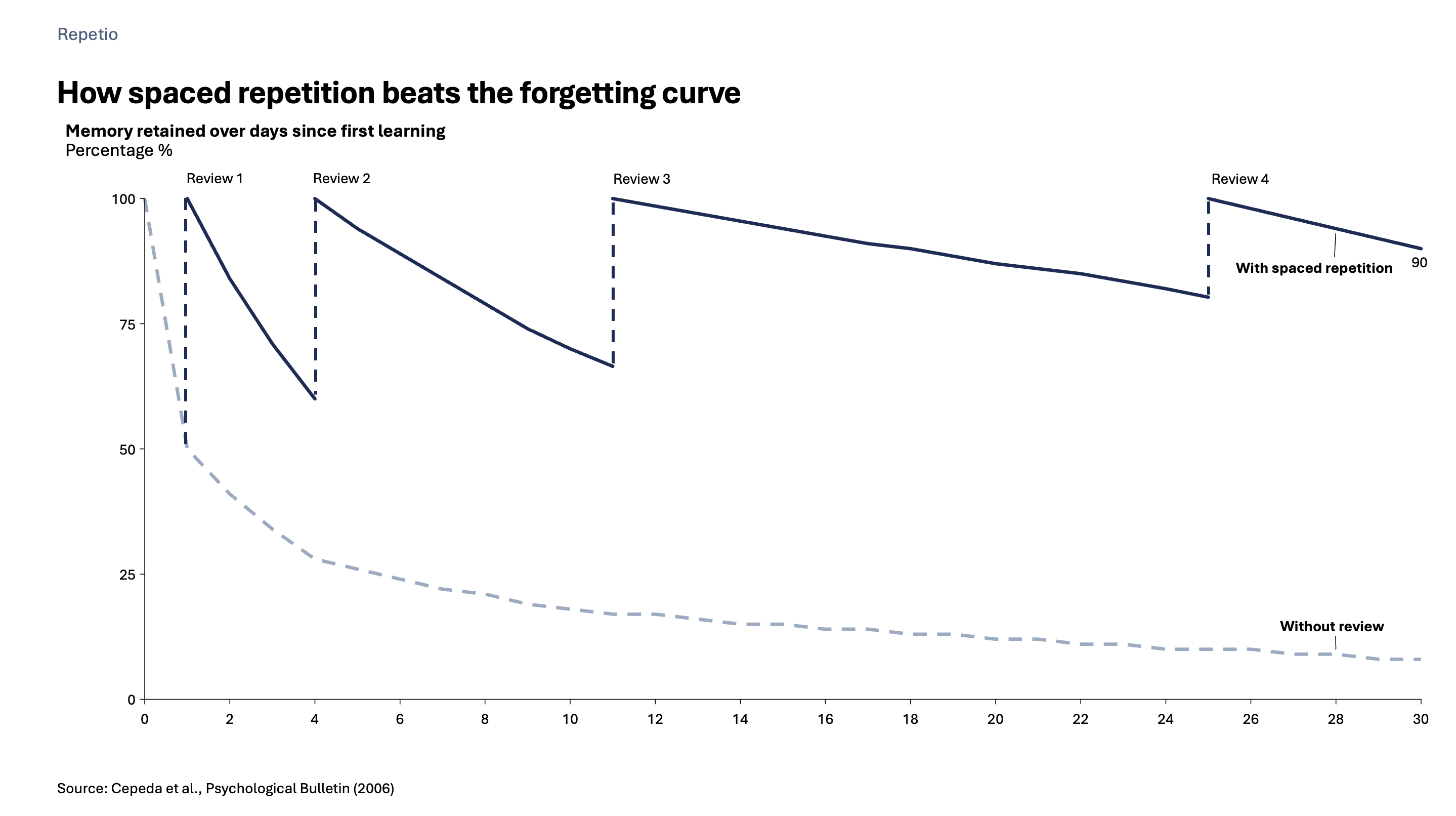
The pattern is remarkably consistent. Memory drops sharply soon after learning and then declines more gradually over days and weeks. Research since Ebbinghaus has repeatedly reproduced the same general shape.
For students in medicine and law, the implications are serious. A medical student may need to retain thousands of facts spanning anatomy, pharmacology, pathology, microbiology, and physiology. A bar exam candidate may need to hold detailed rules across multiple legal subjects simultaneously. Without systematic review, a large percentage of that material disappears long before the exam arrives.
This is the problem spaced repetition was designed to solve.
Spaced Repetition
What Is Spaced Repetition?
Spaced repetition is a review system built around a simple principle: information should be reviewed right before it would otherwise be forgotten.
Each successful review strengthens the memory and slows the rate of future forgetting. Over time, the intervals between reviews become progressively larger. A review schedule might begin with reviews after one day, then four days, then eleven days, then several weeks later. As the memory becomes more stable, less maintenance is required to keep it accessible.
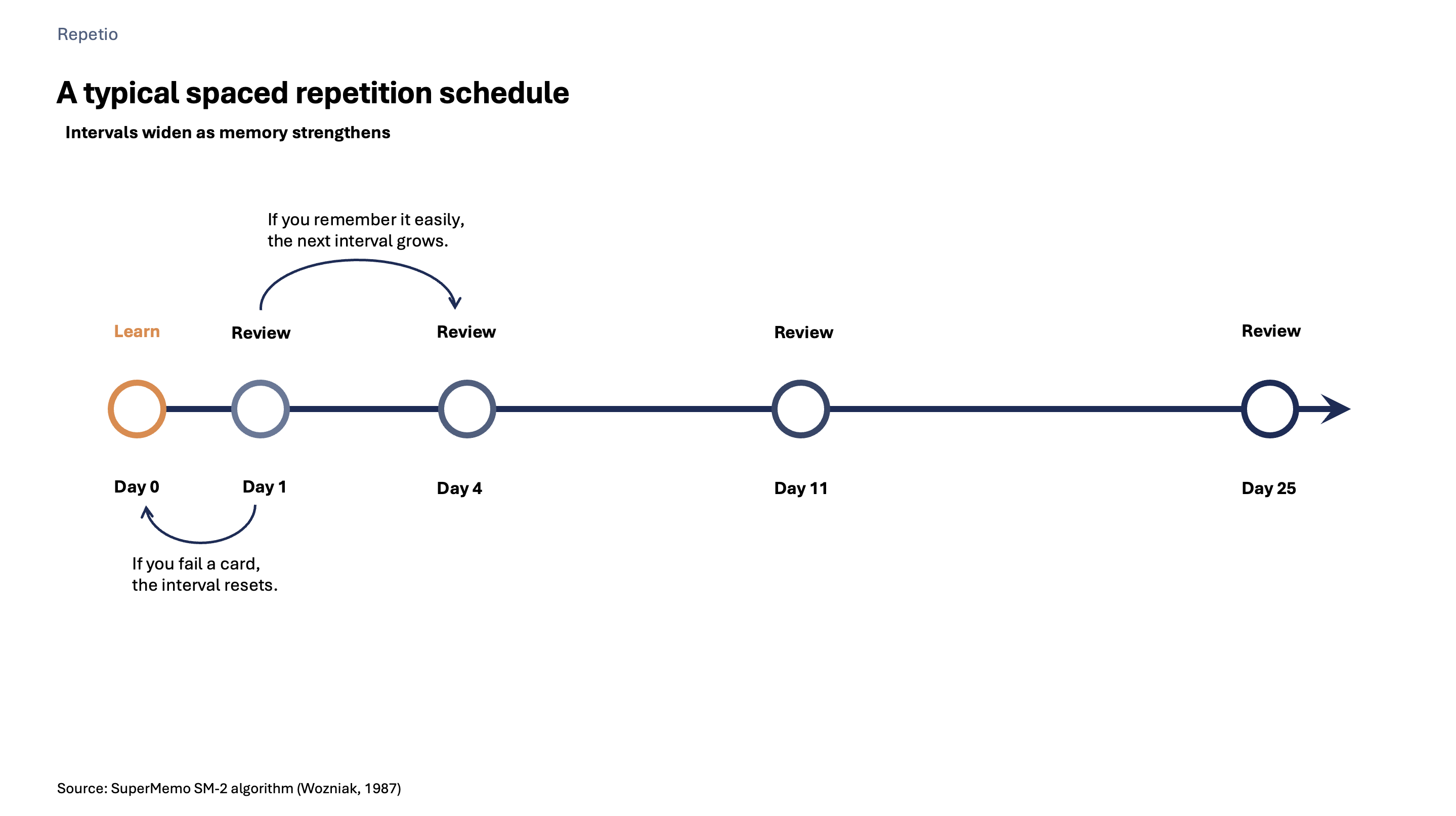
The technique itself predates modern software. Variations of spaced review systems existed long before computers, but digital tools made it possible to automate the scheduling process at scale. Today, apps like Anki and repetio.ai use spaced repetition algorithms to determine when individual cards should reappear based on how easily they were recalled previously.
Why Spaced Repetition Works
The effectiveness of spaced repetition comes from timing. If material is reviewed too early, students waste time reviewing information that is already highly accessible. If review happens too late, the memory may already be gone. Spaced repetition attempts to place review at the point where retrieval is still possible but effortful.
One of the largest studies on the topic was a 2006 meta-analysis by Cepeda and colleagues, which analyzed 317 experiments and 839 individual effect sizes on distributed practice. The conclusion was clear: spaced review consistently produces substantially better long-term retention than cramming or massed review.
This is one reason students who cram often feel well prepared immediately afterward but struggle to retain the information weeks later. Spaced repetition distributes retrieval over time, which dramatically improves memory durability.
How Active Recall and Spaced Repetition Work Together
Although active recall and spaced repetition are often discussed together, they solve different parts of the same problem.
Active recall answers the question of how to study. It replaces passive review with retrieval. Spaced repetition answers the question of when to review. It schedules retrieval according to how memory naturally decays.
The strongest results appear when the two techniques are combined. Active recall without spacing can still produce rapid forgetting, while spacing without retrieval often degenerates into passive rereading. Together, however, they create one of the most effective learning systems currently known.
Research on medical education increasingly reflects this combination. Multiple studies have found that students using active recall and spaced repetition consistently outperform students who rely primarily on passive review methods, including on medical school exams and USMLE-style assessments.
A Practical Workflow for Students
The transition from theory to practice is usually where students struggle most. The underlying rhythm, however, is relatively simple.
The first step is to take notes normally during lectures or readings. Trying to build flashcards in real time often fragments attention and weakens understanding. It is generally better to focus on comprehension first and processing second.
Sometime during the first day after learning the material, the notes can then be converted into flashcards or retrieval questions. The best flashcards tend to be short, specific, and focused on a single idea. A card asking “What nerve innervates the deltoid muscle?” is easier to review consistently than a large card attempting to summarize the entire shoulder.
This conversion process is where many students eventually lose momentum. Rewriting an entire week of lectures into high-quality flashcards can become exhausting, especially in high-volume disciplines.
This is one reason AI-assisted tools have become increasingly useful. Platforms like repetio.ai and ankify.app reduce much of the mechanical work involved in turning lecture slides, PDFs, notes, or handwritten pages into flashcards for spaced repetition. As interest in AI flashcard makers and PDF-to-flashcard tools has grown, these platforms have made it possible to convert study material into review-ready decks far more efficiently than manual card creation.
Instead of spending hours manually rewriting content, students can upload study material and generate review-ready flashcards in seconds. The time saved on flashcard creation can then be spent on the part that actually improves memory: retrieval practice itself. The cognitive work of retrieval still belongs to the learner, but the repetitive formatting work no longer has to.
That reduction in friction matters more than it might initially appear. Most students do not abandon spaced repetition because the method itself fails. They abandon it because the surrounding workflow becomes too time-consuming to sustain consistently.
Comparing the Main Spaced Repetition Apps
Several tools now implement active recall and spaced repetition effectively, although they differ significantly in philosophy and workflow.
Anki remains the most established platform, particularly within medical education. Its greatest strengths are flexibility, customizability, and an enormous ecosystem of community decks. For students willing to tolerate a steeper learning curve and a dated interface, it remains extremely powerful.
repetio.ai focuses more heavily on reducing the friction involved in card creation itself. Instead of requiring students to manually convert large amounts of study material into flashcards, the platform uses AI to generate decks directly from uploaded content. The interface is modern, mobile-friendly, and designed around the reality that consistency is often the limiting factor in long-term spaced repetition.
The important point is that the underlying learning principles remain the same across platforms. The best system is usually the one a student can continue using consistently over long periods of time.
Common Mistakes Students Make
A few mistakes tend to derail students even when they understand the core principles correctly.
The first is mistaking recognition for recall. Looking at a flashcard and thinking “I know this” without actually producing the answer weakens the entire retrieval process.
The second is making cards that attempt to contain too much information at once. Large cards become difficult to review and difficult for spaced repetition algorithms to schedule effectively.
Another common problem is starting too late. Spaced repetition compounds gradually, which means two weeks of intense reviewing before an exam is not equivalent to several months of consistent retrieval practice.
Frequently Asked Questions
Does spaced repetition really work?
The evidence supporting spaced repetition is unusually strong within cognitive psychology. Meta-analyses and educational studies have repeatedly found that distributed retrieval improves long-term retention substantially more than cramming or passive review.
Is active recall better than rereading?
For long-term retention, yes. Rereading can improve familiarity, but retrieval practice produces significantly stronger memory formation.
How long should review intervals be?
Most modern apps calculate intervals automatically based on how well a card was recalled previously. In general, intervals gradually expand as memories become more stable.
Can AI-generated flashcards replace manual studying?
No. AI can reduce the time required to create cards, but the actual learning still happens during retrieval practice.
Does this work for conceptual subjects?
Yes, although spaced repetition is strongest for information with clearly retrievable components such as facts, definitions, rules, mechanisms, and terminology. Higher-level reasoning still requires practice questions, problem-solving, and application exercises.
The Bottom Line
Most students underestimate how quickly memory fades after studying. They work hard, spend long hours reviewing material, and still feel as though information disappears faster than it should. In many cases, the issue is not effort but strategy.
Active recall and spaced repetition work because they align studying with the way memory actually functions. Instead of repeatedly exposing the brain to information, they repeatedly force retrieval over carefully spaced intervals. The result is stronger long-term retention, less forgetting, and a far more efficient approach to learning in high-volume disciplines.
These methods are not shortcuts, and they do not eliminate the need for disciplined work. But they make the work dramatically more effective. And for many students, that difference changes not only exam performance, but the experience of studying itself.
If manual flashcard creation is the part that consistently breaks your workflow, tools like repetio.ai can remove much of that friction. Upload your notes, generate a review deck in minutes, and begin studying the same day.
References
- Roediger, H. L., & Karpicke, J. D. (2006). Test-enhanced learning.
- Cepeda, N. J., et al. (2006). Distributed practice in verbal recall tasks.
- Dunlosky, J., et al. (2013). Improving students' learning with effective learning techniques.
- Murre, J. M. J., & Dros, J. (2015). Replication and analysis of Ebbinghaus' forgetting curve.
- Gilbert, M. M., et al. (2023). Anki usage and medical student performance.